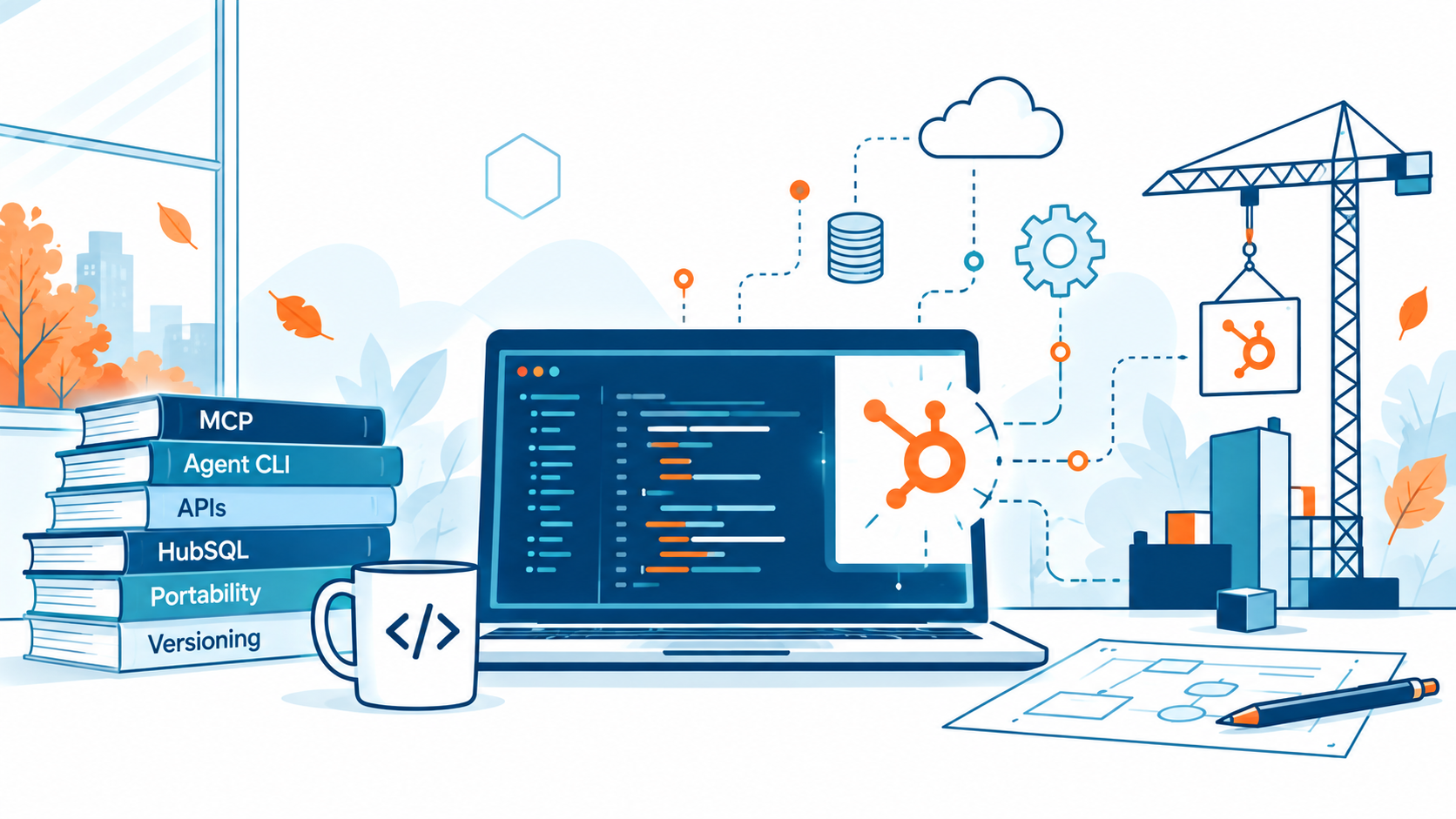
HubSpot's Fall Spotlight 2026 is not only an end-user AI release. The Fall 2026 Developer Spotlight and 2026.09 developer changelog show a significant expansion of the platform developers can use to build agents, integrations, apps and automation around HubSpot.
For Primo Coding, this may be one of the most important parts of the release.
Native HubSpot features can solve a growing number of business problems. But when a requirement crosses systems, needs custom logic, uses a specialized data model or requires a more tailored experience, the developer platform becomes the implementation layer.
The Developer Story Behind Fall Spotlight
The larger pattern is that HubSpot is giving developers more ways to work with the same business context its AI products rely on.
That matters because the question is no longer only, “What can Breeze do?” It is also, “What can we build around HubSpot when the native feature does not solve the whole requirement?”
Expanded MCP: AI Can Reach More of HubSpot
HubSpot says its MCP server expanded significantly in the Fall 2026 release. AI tools and agents can work across more CRM objects and can perform additional write and configuration actions.
The 2026.09 changelog specifically describes read/write support for custom objects and additional CRM objects, plus capabilities around custom properties, pipelines and stages. Writes remain subject to HubSpot permissions and audit logging.
For developers, that makes MCP more than a convenient way to query CRM data. It becomes a bridge between AI tools and the HubSpot data model.
Agent CLI: AI-Assisted Work for Developers and Operators
HubSpot's Developer Spotlight also introduces Agent CLI as part of its AI-building toolset. HubSpot positions it for autonomous bulk actions and repetitive work such as pipeline scans, account reviews and reporting.
The opportunity here is not to replace every script or integration with an agent. It is to identify repetitive technical or operational work where an agent can use clear instructions, HubSpot context and controlled actions to reduce manual effort.
HubSpot MCP and Agent Builder Can Extend Beyond HubSpot
HubSpot also documents the ability to connect Agent Builder to external business systems through MCP. That allows agents to access live data and perform actions across supported external applications.
HubSpot is also allowing app developers to expose their own remote MCP server tools inside HubSpot Agents through an MCP server component. That creates an interesting path for software vendors and solution providers that want their application capabilities available inside Agent Builder.
Portability Could Matter a Lot for Partners and Multi-Portal Teams
Portability is currently listed as public beta in HubSpot's Developer Spotlight.
HubSpot says teams can move assets such as workflows, forms, agents, lists and emails between portals. For partners, that could make reusable solutions and repeatable implementation patterns much more practical.
For Primo, this is worth watching closely because it could change how we package proven architecture and automation across similar client use cases without treating every portal as a completely blank build.
Date-Based API Versioning Makes Change More Predictable
HubSpot's date-based API versioning replaces the older mix of v1/v2/v3-style versioning with dated releases. New API versions are scheduled twice per year, in March and September, with each version receiving a minimum 18-month support window.
For companies that depend on HubSpot integrations, predictability matters. It gives development teams a clearer maintenance window instead of treating API changes as surprise repair work.
Granular Scopes: Better Least-Privilege Access
HubSpot is also moving toward more granular permission scopes for integrations. Instead of broad access, apps can request more precise permissions.
That matters for implementation and governance because customers can better understand what an integration can access, while developers can design around least-privilege principles.
New and Expanded APIs Increase What Can Be Built
The 2026.09 release includes new and expanded APIs across CRM, automation and platform capabilities. HubSpot's changelog lists public-beta APIs including Lead Scoring, Contracts, AEO, Marketing Forms, Automation Workflows, Scheduler, Subscriptions Lifecycle and Activity Auto Associations.
HubSpot also updated 44 existing APIs for the 2026.09 release. Most are version-parity updates that make the same endpoints available on the stable 2026.09 version, while a smaller number include additional capabilities.
HubSpot's Developer Spotlight also highlights additional platform work including Conversations, Price Books and Teams APIs.
The practical takeaway is not that every company should build against every new API. It is that the range of business processes developers can connect to HubSpot continues to expand.
HubSQL Is Worth Watching, But It Is Still Private Beta
HubSpot lists HubSQL API as private beta. The stated direction is the ability to query HubSpot data using standard SQL concepts such as filters, joins, aggregations and calculations, including through the query_crm_data MCP tool.
That could become important for analytics and AI use cases, but because it is private beta, we would not design a production client solution around it until availability and requirements are confirmed for that account.
Projects Platform 2026.09 and User-Level Apps
HubSpot's Developer Spotlight also highlights Projects Platform version 2026.09 with support for user-level apps that enforce individual permissions and data access instead of relying only on broad portal-level access.
That reinforces another Fall Spotlight theme: as AI and integrations gain more ability to act, permissions and governance have to become more precise too.
What Should HubSpot Customers Do With All of This?
Most HubSpot customers do not need to memorize the API release list.
The more useful questions are:
- Where does a business process break because HubSpot and another system do not share the right data?
- Where is the team doing repeatable technical or operational work manually?
- Where could an agent help if it had access to the right CRM and external-system context?
- Which existing integrations rely on legacy APIs or app frameworks that need a migration plan?
- Where could reusable portal assets reduce implementation time across business units, brands or client portals?
- What permissions and governance should be in place before AI or integrations are allowed to write data or take actions?
A Note for Teams With Existing HubSpot Integrations
This release is also a reminder to inventory what your existing integrations depend on. HubSpot has announced that v1–v3 APIs, legacy public apps and legacy private apps will move to unsupported status in September 2027. v4 APIs have a separate March 30, 2027 unsupported date.
If your business depends on a custom integration, this is a good time to identify the APIs, authentication method, app framework and ownership behind it, then determine whether a migration is required. Waiting until an unsupported API or legacy app creates a production problem turns planned maintenance into an emergency.
Where Primo Coding Fits
This may be the part of Fall Spotlight that connects most directly to Primo's technical work.
We work across HubSpot architecture, custom development, integrations, automation and AI. When a native HubSpot feature solves the problem cleanly, we can implement it. When the requirement crosses systems or needs custom logic, the developer platform gives us more ways to build around the CRM rather than forcing the business into a one-size-fits-all process.
That can include HubSpot development, AI agents and assistants, integrations and custom automation.
The goal is not to use every new API, agent or developer tool. It is to choose the smallest set of capabilities that can improve the outcome and build them on a foundation the business can maintain.
Outcome → Context → Right Tool → Implementation → Result
Explore the rest of our Fall Spotlight 2026 analysis or talk to Primo about a technical HubSpot requirement.
Frequently Asked Questions
What is HubSpot MCP?
Model Context Protocol, or MCP, is a standard that lets AI tools connect to supported data and tools. HubSpot's MCP capabilities allow compatible AI tools and agents to work with HubSpot context and, where supported and permitted, take actions.
What is HubSpot Agent CLI?
Agent CLI is part of HubSpot's AI developer toolset for using agents in technical and operational workflows. HubSpot highlights repeatable work such as pipeline scans, account reviews and reports as example applications.
Is HubSpot Portability generally available?
No. HubSpot currently lists Portability as public beta.
Is HubSQL generally available?
No. HubSpot currently lists HubSQL API as private beta.
What is HubSpot's current API versioning approach?
HubSpot is moving to date-based API versions. Breaking changes are planned on a predictable cadence, and HubSpot states that each version receives a minimum 18-month support window.