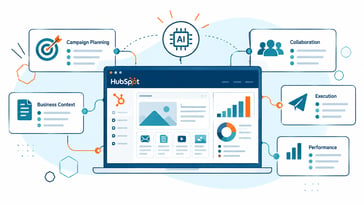
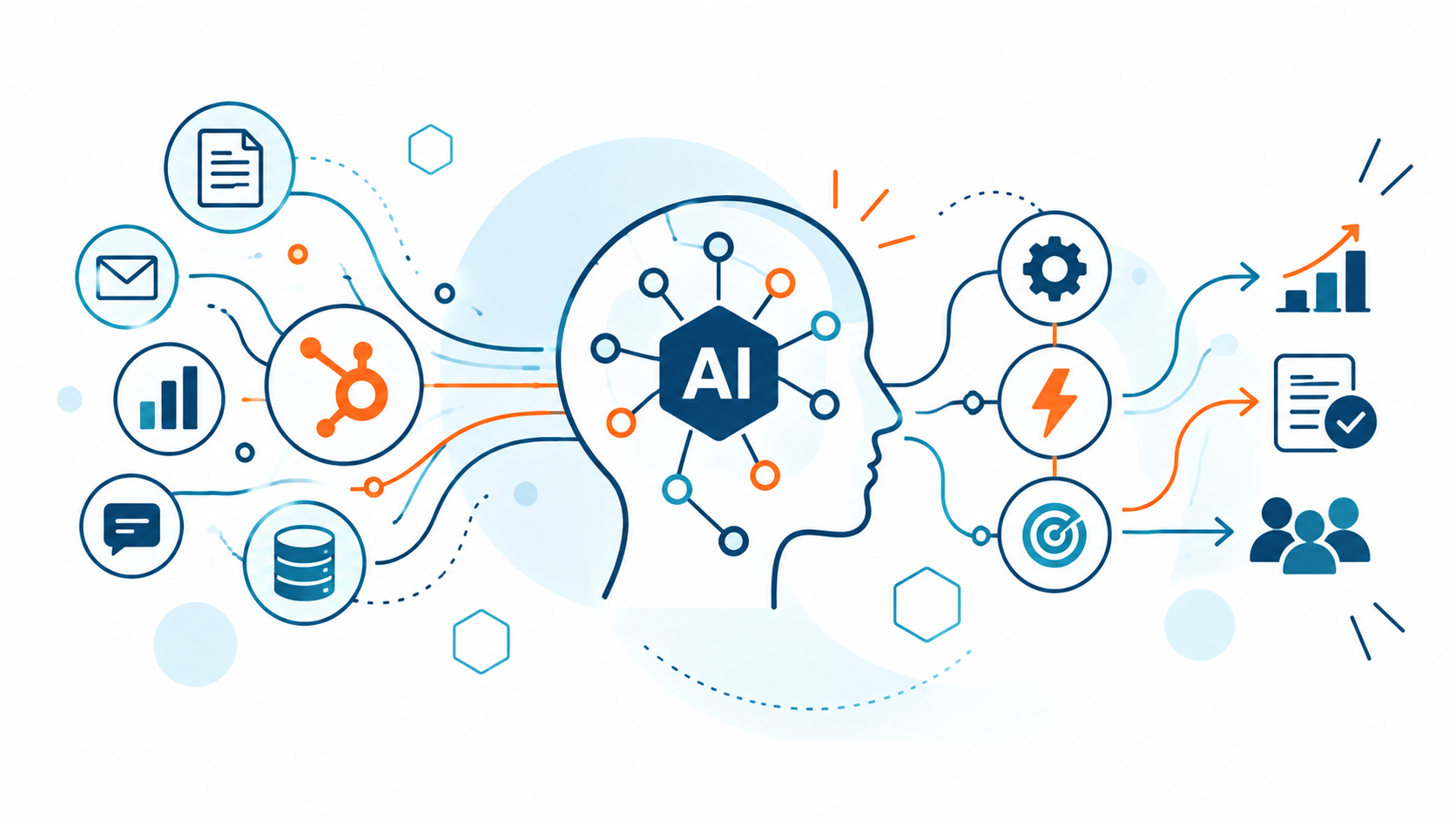
HubSpot calls the foundation behind its AI strategy Growth Context: the understanding HubSpot builds about your customers, your team and your business. The idea is simple: AI becomes more useful when it understands the business it is working for, the people it is working with and the customers it is trying to serve.
Sam Marks came out of Partner Day with three words for our team: Context. Context. Context.
That may be the most important theme in this entire release cycle.
Why Context Matters More as AI Does More
When AI is only helping write a first draft, missing context is annoying. When AI is researching records, recommending actions, updating data or participating in a workflow, missing context becomes a much bigger implementation problem.
The more responsibility AI gets, the more important it becomes to define what it knows, what it can access, what it may do and when a human needs to stay involved.
What Is HubSpot Growth Context?
Growth Context is not one field or one document. It brings together what HubSpot knows about your customers, your team and your business. That can include CRM records, customer history, business definitions, ICPs, brand positioning, approved content, process documentation, files and knowledge sources.
HubSpot's current documentation for knowledge vaults shows how curated files, HubSpot content and segments can be made available to projects and agents.
What Is HubSpot Context Home?
HubSpot Context Home is a central place to see and manage the Growth Context informing AI and agents across HubSpot. It shows what HubSpot understands about your business, customers, team and processes so you can identify gaps, correct inaccurate information and keep that context current as your business changes.
HubSpot also provides a context score designed to show how complete the context foundation is and where improvements may be needed.
That matters because context is not something a business configures once and forgets. Products change. Ideal customer profiles evolve. Processes change. Teams learn. If AI is going to participate in real work, the context informing that work needs to evolve too.
Context Is Not the Same as More Data
More data does not automatically create better context. Duplicate records, stale documentation, conflicting definitions and irrelevant information can make AI less reliable, not more useful.
The goal is not to give an agent everything. The goal is to give it the right information for the outcome it is responsible for.
Start With the Outcome
One of the strongest themes across Fall Spotlight 2026 was that outcomes matter more than implementing every available tool.
We would frame the implementation path this way: Outcome → Context → Right Tool → Implementation → Result.
Define the business outcome first. Then identify the context required to make good decisions. Only then choose whether Breeze, an agent, a workflow, an integration or another solution is the right tool.
What Should Companies Get Right Before Scaling Agents?
- Clean and consistent CRM data.
- Clear business definitions and ownership.
- Current documentation and approved knowledge sources.
- Defined permissions and action boundaries.
- Human review for important or ambiguous decisions.
- A process for maintaining context as the business changes.
- A measurable outcome for the agent or AI workflow.
- A plan for reviewing and maintaining the information in Context Home.
The Technical Foundation Matters More, Not Less
AI doesn't make CRM cleanup, integrations and good processes less important. It makes them more important.
That's where HubSpot architecture and optimization, AI agents and assistants and integrations can converge. The AI layer only works as well as the business systems and context underneath it.
Primo's Take
The exciting part of Growth Context isn't that HubSpot has given context a name. It's that the platform is increasingly treating context as infrastructure for AI and agents.
For customers, that means AI readiness should include more than deciding which model or feature to use. It should include the quality of the CRM, the knowledge layer, the processes, the permissions and the systems AI will depend on. It should also include an ongoing plan for keeping that context accurate as the business changes.
Not sure whether your HubSpot portal is ready for AI and agents? Primo Coding can help evaluate the CRM data, business context, integrations, processes and technical foundation they'll depend on.
Explore our Fall Spotlight 2026 analysis or talk to Primo about AI + HubSpot.